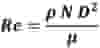
When mixing in a tank, the Reynolds number (Re) tells us how the fluid will flow. The appearance of turbulent motion corresponds to a Reynolds number of about 3,000.
As this number rises, turbulence increases, leading to noticeable changes in the mixing operation appearance. This becomes completely turbulent for a Reynolds number above 6,000.
- Re < 3,000: the flow is laminar.
The flow is slow and smooth and layered, meaning that two separate flows move in the same direction in parallel layers, involving a slow mixing.
This occurs with high viscous fluids like adhesives, polymers, wastewater sludge or creams. Low-shear impellers are used to avoid damaging the product.
- 3,000 < Re < 6,000: the flow is transitional, unstable, in between the two states.
This occurs with fluids having medium‑viscosity such as syrups and slurries.
- Re > 6,000 the flow is turbulent. In industrial mixing, turbulent flow is generally the ideal condition to achieve.
In turbulent regime, the fluid doesn’t flow in layers. The flow is chaotic, energetic, involving an energic mixing, much faster to allow good dispersion and maintain in suspension.
This is the most common flow regime in the industry where industrial mixers are used. Water and solvents for instance, both are low viscous products that can be easily mixed.
Calculation example with water:
Water at 20 °C (68 °F): ρ ≈ 1000 kg·m⁻³, μ ≈ 0.001 Pa·s
- Impeller diameter: D = 2 m
- Mixer Rotation Speed: 180 rpm. Then N = 180/60 = 3 s⁻¹
With Re = 12,000,000: the flow is turbulent. Expect strong blending, good suspension (with proper off‑bottom clearance and baffles).