
Products
Metering Pumps
Process Pumps
Mixers
Systems & Skids
Electronics and Metering
Valves and Accessories
Industries & Applications
Water Treatment
Energy
Pyrolysis Plastics Recycling
Lithium Mining
Essential Pil Extraction
Palm Oil Production
Technology
Water Treatment
Energy
General Industry
Metering Pump Technology
Metering Pump Principles
Petrochemical Industry
Aftermarket & Support
CARE Maintenance Plans
Spare Parts Inventory
Resources
White Paper
Case Studies
Webinars on Demand
Digital Support Files
Certifications
Milton Roy YouTube Channel
Sales Terms & Conditions
About Us
News
Knowledge Hub
Careers
Sign Up for Newsletter
Back to the product list

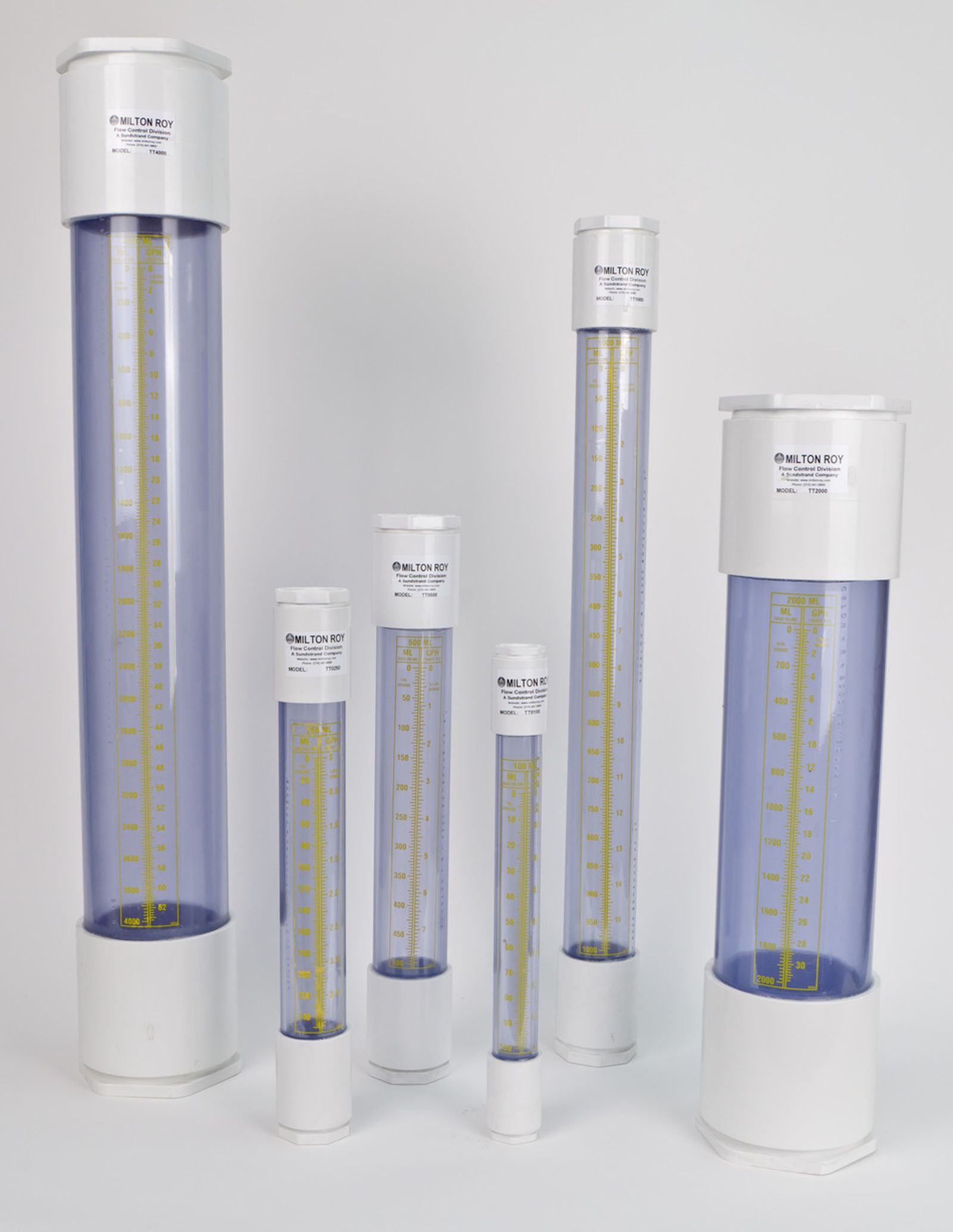
Calibration Columns, Accurate Flow Verification Made Simple

Calibration columns are a fast, easy, and economical means of checking flow rates of Milton Roy metering pumps. These devices allow operators to perform periodic monitoring and verification of pump flow rate, ensuring optimal performance and injection accuracy. They are also essential for verifying pump capacity after routine maintenance or troubleshooting dosing issues.

Milton Roy calibration columns are:

  • Available in several sizes to suit different pump capacities.
  • Constructed from durable, chemical-resistant materials for long service life.
  • Graduated precise measurement, enabling accurate calculation of flow rates.
  • Easy to install on the suction side of the pump without special tools.

To help us prepare your quotation, please specify:

  1. The required calibration column size or your pump flow rate(s)
  2. Specifications of the fluid being injected or any preferred construction materials
  3. Your preferred connection size and type.

Calibration columns provide an accurate precise and visual method to confirm the actual flow rate of your Milton Roy metering pump in your real conditions of operation. This ensures that chemical dosing matches the required specifications, reducing the risk of under- or over-injection.

  • Quick and cost-effective performance checks.
  • Helps maintain compliance with dosing specifications.
  • Reduces risk of under- or over-injection of chemicals.
  • Improves overall system reliability.
  • Available in six sizes
  • Fast, easy, and economical
  • Accurate injection
  • Optimal performance
  • Easy installation

FAQ

A calibration column, also named calibration pot, is a transparent, graduated cylinder installed on the suction side of a metering pump. It allows operators to visually measure and verify the actual flow rate of the pump by observing the liquid level change over time.

The principle is simple:

  • The column is filled with the fluid being dosed.
  • When the pump operates, it draws liquid from the column.
  • The operator measures the time it takes for the liquid level to drop between two graduations.
  • Using this time and the volume difference, the actual pump flow rate (in l/h or GPH) is calculated.

This process helps verify that the pump is delivering the correct amount of fluid compared to its theoretical setting.

Sizing depends on:

  • Pump capacity (maximum flow rate)
  • Desired measurement accuracy
  • Chemical properties (viscosity, density)

The calibration pot must have sufficient capacity to ensure that the measurement time is not too short. A minimum measuring time of 30 seconds is necessary.

To avoid calculations, Milton Roy recommends performing the measurement over periods of 36 seconds. The capacity of the measuring pot will then correspond to the hourly flow rate, expressed in l/h or GPH, divided by 100.

For instance, your pump has a flow rate of 40 l/h, you need to use a calibration column of:

40 l/h divided by 100 = 0.4 l/h

0.4l/h divided by 36 s = 0.5 l = 500 ml

Choose the next largest capacity for your calibration pot with a minimum volume of 500 ml.

Milton Roy offers several standard sizes to accurately calibrate your dosing pumps.

Choosing the right size ensures the level drop is measurable within a reasonable time (usually 30 - 60 seconds).

Step-by-step procedure:

  1. Isolate the pump suction from the main chemical tank and connect it to the calibration column.
  2. Fill the column with the chemical solution or fluid to inject to the top graduation mark.
  3. Start the pump at the desired stroke length and speed.
  4. Measure the time it takes for the liquid level to drop from one graduation mark to another (for instance from 100 ml to 50 ml).
  5. Calculate flow rate using the formula:
    Real Flow Rate = Volume (ml) / Time (s) x 3600
    That is why we always recommend to use multiple of 36 s to simplify.
    Example: If 50 ml is injected in 36 seconds:
    Real Flow Rate = 50 ml x 100 = 5,000 ml/h = 5 l/h
  6. Compare this actual flow rate to the pump’s rated capacity and adjust settings if necessary.
Find a Sales Rep