Products
Metering Pumps
Process Pumps
Mixers
Systems & Skids
Electronics and Metering
Valves and Accessories
Industries & Applications
Water Treatment
Energy
Pyrolysis Plastics Recycling
Lithium Mining
Essential Pil Extraction
Palm Oil Production
Technology
Metering Pump Technology
Metering Pump Principles
Petrochemical Industry
Aftermarket & Support
CARE Maintenance Plans
Spare Parts Inventory
Resources
White Paper
Case Studies
Webinars on Demand
Digital Support Files
Certifications
Milton Roy YouTube Channel
Sales Terms & Conditions
About Us
News
Knowledge Hub
Careers
Sign Up for Newsletter

Global demand for essential oils continues to grow across industries including pharmaceuticals, food and beverage, cosmetics, aromatherapy, and wellness. As consumers seek natural products extracted from plant material, manufacturers face increasing pressure to scale production while preserving oil purity, consistency, and operational safety.

To meet this demand, the essential oil industry is continuously refining traditional and advanced extraction methods—from steam distillation and cold pressing to modern CO₂ extraction—with a strong emphasis on system reliability, efficiency, and uptime. Dependable extraction systems are critical not only for maximizing yield, but also for protecting delicate volatile compounds and ensuring repeatable product quality.

Overview of Essential Oil Extraction Methods

Essential oils are derived from a wide variety of plants, each containing unique plant compounds that respond differently to heat, pressure, water, or solvents. For this reason, multiple extraction methods are used across the essential oil industry, each suited to specific types of plant material and desired oil characteristics.

Below is an overview of the most widely used methods, with practical examples for each.
Best for: Hardy herbs, leaves, woods, and roots

Steam distillation is the most traditional and widely recognized method for producing essential oils. In this process, steam passes through prepared plant material, causing volatile compounds to evaporate. The vapor is then cooled and condensed into a mixture of water and oils, which naturally separate due to differences in density.

Because essential oils are hydrophobic, oil floating above the water phase (hydrosol) can be easily collected.

Common examples:

  • Lavender oil – extracted from lavender flowers
  • Eucalyptus oil – extracted from eucalyptus leaves
  • Peppermint oil – extracted from flowering tops and leaves
  • Tea tree oil – extracted from tea tree leaves and twigs
  • Cedarwood oil – extracted from wood chips

Key advantages:

  • Well‑established and cost‑effective
  • Scalable for industrial production
  • Ideal for oils used in aromatherapy and cosmetics

Choosing the Right Extraction Method

No single extraction method is suitable for all botanicals. Factors that influence method selection include:

  • Plant type and structure
  • Desired aroma profile
  • Sensitivity of volatile compounds
  • Yield expectations
  • End‑use (aromatherapy, food, cosmetics, pharmaceuticals)

Modern essential oil producers frequently combine traditional techniques such as steam distillation with advanced technologies like CO₂ extraction to optimize both quality and throughput.

How a Supercritical CO₂ Extraction System Works (Process Overview)

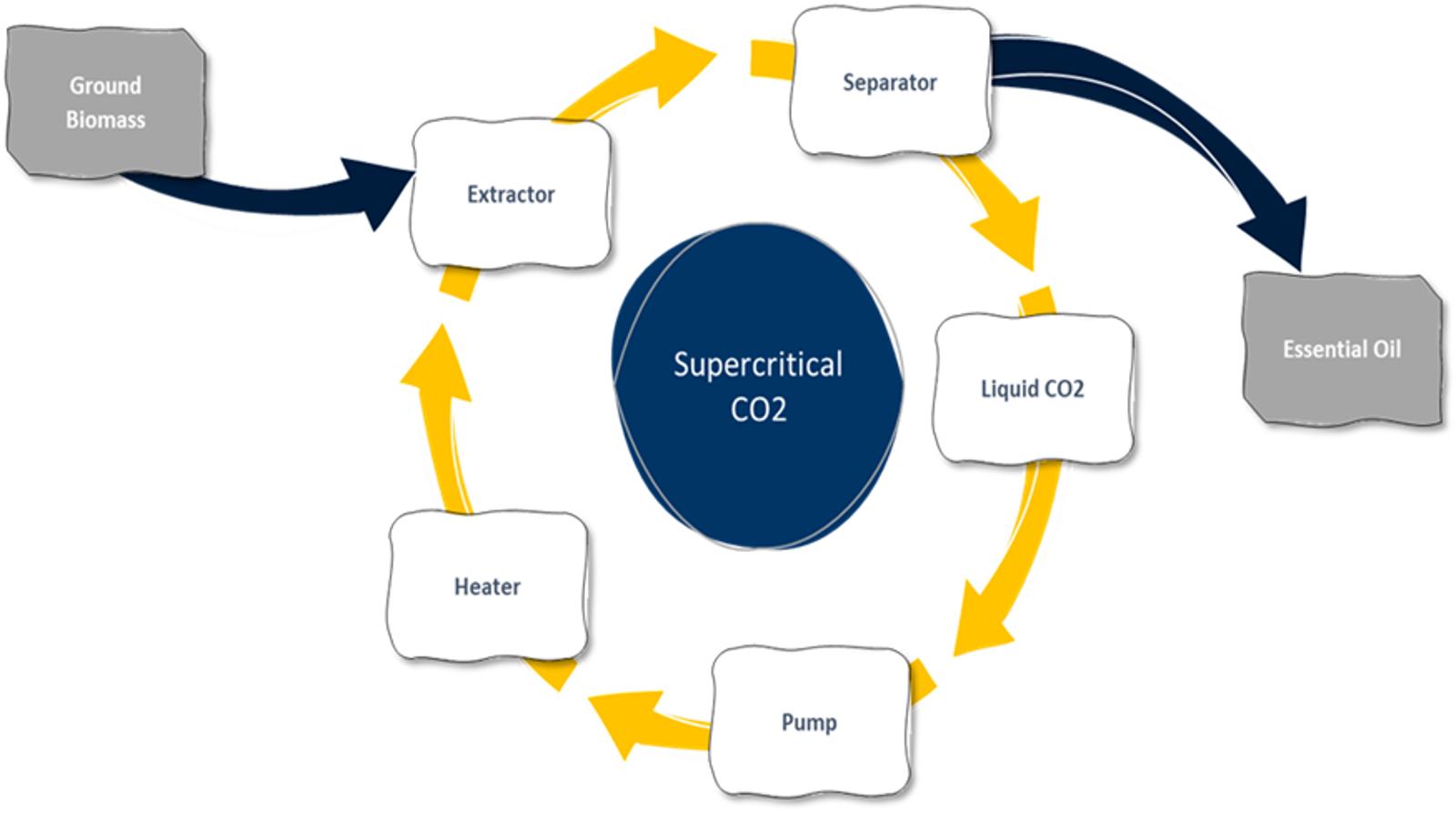
The schematic below illustrates a closed‑loop supercritical CO₂ extraction system designed for the efficient recovery of essential oils, botanical extracts, and other high‑value plant compounds. 

Unlike traditional extraction methods that rely on high heat or aggressive chemical solvents, supercritical CO₂ extraction uses carbon dioxide under carefully controlled pressure and temperature conditions to gently isolate volatile aromatic compounds while preserving product purity and integrity.

essential-oil-extraction
The process begins with carefully prepared plant material. Botanical biomass is dried, milled, or ground to create a uniform particle size that maximizes surface area and improves contact with the CO₂ during extraction. Proper preparation is essential for optimizing extraction efficiency, consistency, and overall yield. Depending on the application, the biomass may include herbs, flowers, spices, hemp, medicinal plants, or essential oil crops.

Why the Industry Prefers Supercritical CO₂ Extraction

Supercritical CO₂ extraction has become one of the most widely adopted advanced extraction methods due to its combination of purity, flexibility, and efficiency:

  • Clean and Solvent‑Free Carbon dioxide is naturally occurring and leaves no residue, producing pure essential oils without the need for chemical cleanup or dilution in a carrier oil.
  • Gentle on Volatile Compounds Lower operating temperatures protect sensitive aromatic molecules that may degrade during steam distillation.
  • Highly Selective Operators can fine‑tune pressure and temperature to target specific plant compounds.
  • Proven Across Industries Widely used for hops, spices, nutraceuticals, flavors, and fragrances—not limited to cannabis applications.

Frequently Asked Questions (FAQ)

Essential oils are concentrated aromatic liquids composed of volatile plant compounds extracted from leaves, flowers, bark, roots, seeds, or fruit peels.