Products
Mixers
Technology
Resources
miltonroy-logo.jpg

Contact Our Extraction Experts

Connect with our experts to discuss your essential oil or botanical extraction application, operating conditions, and uptime goals. We’re here to help you identify pump solutions designed for consistent performance and long‑term reliability.

Global demand for essential oils continues to grow across industries including pharmaceuticals, food and beverage, cosmetics, aromatherapy, and wellness. As consumers seek natural products extracted from plant material, manufacturers face increasing pressure to scale production while preserving oil purity, consistency, and operational safety.

To meet this demand, the essential oil industry is continuously refining traditional and advanced extraction methods—from steam distillation and cold pressing to modern CO₂ extraction—with a strong emphasis on system reliability, efficiency, and uptime. Dependable extraction systems are critical not only for maximizing yield, but also for protecting delicate volatile compounds and ensuring repeatable product quality.

Overview of Essential Oil Extraction Methods

Essential oils are derived from a wide variety of plants, each containing unique plant compounds that respond differently to heat, pressure, water, or solvents. For this reason, multiple extraction methods are used across the essential oil industry, each suited to specific types of plant material and desired oil characteristics.

Below is an overview of the most widely used methods, with practical examples for each.
1. Steam Distillation

Best for: Hardy herbs, leaves, woods, and roots

Steam distillation is the most traditional and widely recognized method for producing essential oils. In this process, steam passes through prepared plant material, causing volatile compounds to evaporate. The vapor is then cooled and condensed into a mixture of water and oils, which naturally separate due to differences in density.

Because essential oils are hydrophobic, oil floating above the water phase (hydrosol) can be easily collected.

Common examples:

  • Lavender oil – extracted from lavender flowers
  • Eucalyptus oil – extracted from eucalyptus leaves
  • Peppermint oil – extracted from flowering tops and leaves
  • Tea tree oil – extracted from tea tree leaves and twigs
  • Cedarwood oil – extracted from wood chips

Key advantages:

  • Well‑established and cost‑effective
  • Scalable for industrial production
  • Ideal for oils used in aromatherapy and cosmetics

2. Cold Pressing

Best for: Citrus fruits

Cold pressing is a mechanical process that physically ruptures oil glands without applying heat. This method is almost exclusively used for citrus oils because their aromatic compounds are concentrated in the outer rind or fruit peels.

Unlike steam distillation, cold pressing retains the fresh, bright top notes of citrus oils but may include waxes and pigments.

Common examples:

  • Sweet orange oil – cold‑pressed from orange peels
  • Lemon oil – extracted from lemon rinds
  • Bergamot oil – obtained from bergamot orange peels
  • Grapefruit oil – expressed from grapefruit peel

Key advantages:

  • Heat‑free process preserves aroma
  • Simple mechanical operation
  • High yield from citrus sources

3. Solvent Extraction

Best for: Delicate flowers and fragile plant material

Solvent extraction uses food‑grade solvents to dissolve aromatic compounds from plant material that cannot withstand heat or steam. The solvent is later removed, leaving behind a concentrated aromatic extract.

This method is often used when steam distillation would damage the oil profile or produce very low yields.

Common examples:

  • Jasmine absolute – extracted from jasmine blossoms
  • Rose absolute – extracted from rose petals
  • Tuberose extract – used in fine perfumery

Key considerations:

  • Requires careful solvent removal
  • Additional processing steps
  • Used mostly for perfumery rather than therapeutic oils

4. Supercritical CO2 Extraction

Best for: High‑value botanicals, heat‑sensitive compounds, specialty oils

CO₂ extraction uses carbon dioxide under carefully controlled pressure and temperature. When CO₂ enters its supercritical state, it exhibits properties of both a gas and a liquid, making it an exceptionally efficient solvent for extracting essential oils and other plant compounds.

Because the process operates at relatively low temperatures, it preserves delicate aromatic molecules and compounds that may become solid at room temperature.

Common examples:

  • Hops extract – used in beer brewing
  • Ginger extract – high aroma and pungency retention
  • Turmeric extract – rich in curcuminoids
  • Vanilla CO₂ extract – cleaner profile than solvent extraction
  • Herbal extracts such as rosemary, sage, and thyme

Key advantages:

  • No chemical solvent residues
  • Highly selective extraction
  • Little to no post‑processing required
  • Produces clean oils that often do not require dilution in a carrier oil

Choosing the Right Extraction Method

No single extraction method is suitable for all botanicals. Factors that influence method selection include:

  • Plant type and structure
  • Desired aroma profile
  • Sensitivity of volatile compounds
  • Yield expectations
  • End‑use (aromatherapy, food, cosmetics, pharmaceuticals)

Modern essential oil producers frequently combine traditional techniques such as steam distillation with advanced technologies like CO₂ extraction to optimize both quality and throughput.

How a Supercritical CO₂ Extraction System Works (Process Overview)

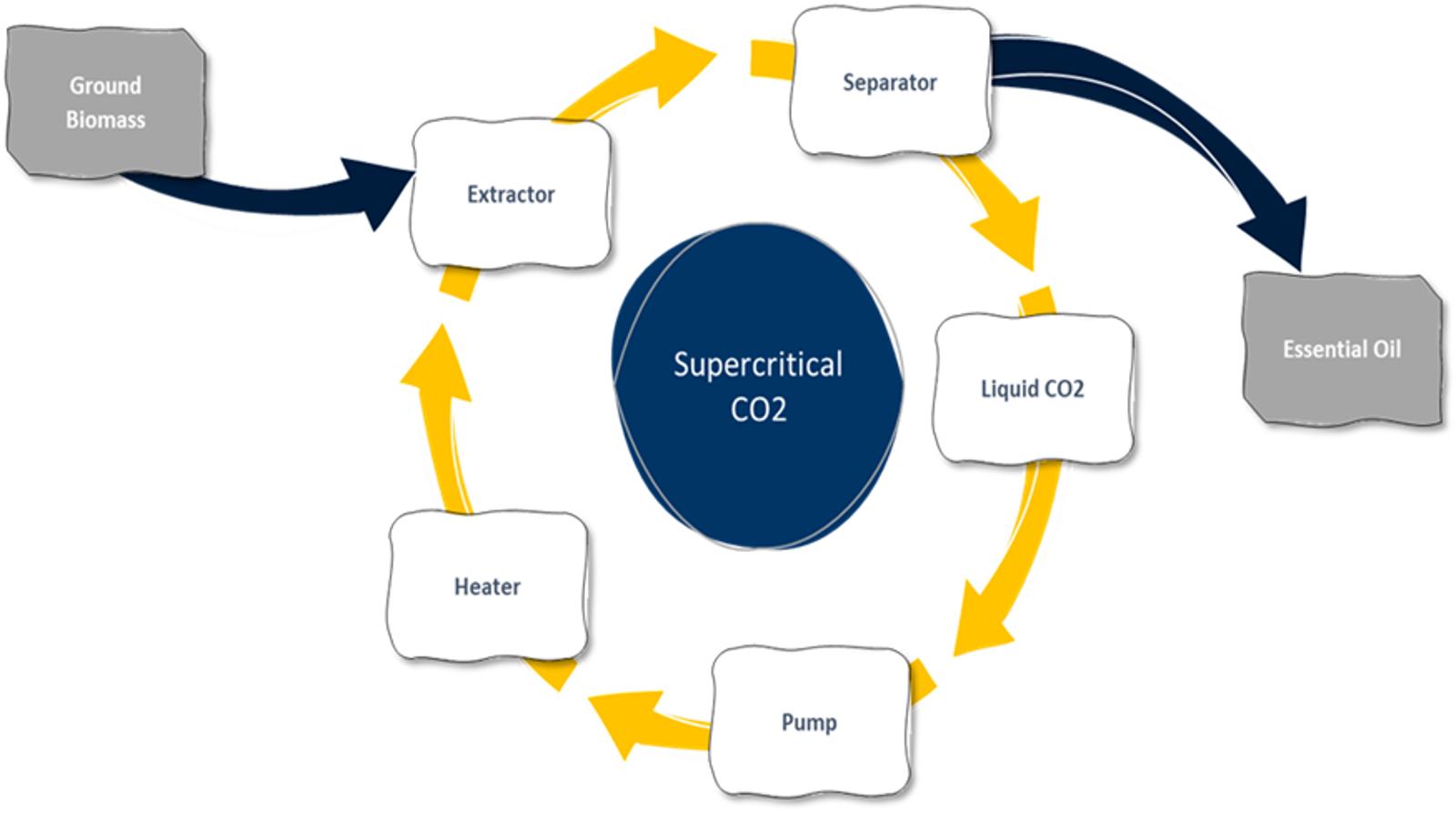
The schematic illustrates a closed‑loop supercritical CO₂ extraction system, designed for efficient, continuous recovery of essential oils and other valuable plant compounds.

essential-oil-extraction

Process summary:

  1. Ground Biomass
    Prepared plant material is loaded into the extractor to maximize surface contact with CO₂.
  2. Extractor
    Supercritical CO₂ flows through the biomass, dissolving essential oils and volatile compounds without thermal degradation.
  3. Separator
    Pressure and temperature are adjusted, allowing the extracted oils to separate from the CO₂ stream—mirroring the natural separation seen in traditional distillation, but without water or heat stress.
  4. Essential Oil Collection
    Pure essential oil is recovered, free of chemical solvents and typically requiring little to no post‑processing.
  5. Liquid CO₂ Recovery
    The CO₂, now free of oils, is condensed back into liquid form.
  6. Pump
    Liquid CO₂ is pressurized to extraction conditions, maintaining consistent flow and system stability.
  7. Heater
    The CO₂ is precisely heated to reach or maintain its supercritical state before re‑entering the extractor.

This closed‑loop design allows carbon dioxide to be continuously reused, improving sustainability, operating economics, and overall uptime while delivering high‑quality distilled oils across a wide range of botanical inputs.

Why the Industry Prefers Supercritical CO₂ Extraction

Supercritical CO₂ extraction has become one of the most widely adopted advanced extraction methods due to its combination of purity, flexibility, and efficiency:

  • Clean and Solvent‑FreeCarbon dioxide is naturally occurring and leaves no residue, producing pure essential oils without the need for chemical cleanup or dilution in a carrier oil.
  • Gentle on Volatile CompoundsLower operating temperatures protect sensitive aromatic molecules that may degrade during steam distillation.
  • Highly SelectiveOperators can fine‑tune pressure and temperature to target specific plant compounds.
  • Proven Across IndustriesWidely used for hops, spices, nutraceuticals, flavors, and fragrances—not limited to cannabis applications.

Pump Reliability: The Key to Extraction Uptime

While each component in a supercritical CO₂ system is important, the pump plays a defining role in overall system uptime and extraction efficiency. It governs CO₂ flow rate, pressure stability, and consistency throughout the closed loop.

Any variation or failure in pump performance can:

  • Disrupt supercritical conditions
  • Reduce extraction efficiency
  • Cause process interruptions and costly downtime

With over 85 years of engineering expertise, Milton Roy® pumps are designed specifically for high‑pressure, high‑duty extraction applications. Their precision metering, robust construction, and long service life support continuous operation and reliable performance across a wide range of essential oil and botanical extraction processes.

Selecting the right pump ensures stable supercritical conditions, maximizes throughput, and protects both product quality and production uptime.

Frequently Asked Questions (FAQ)

Essential oils are concentrated aromatic liquids composed of volatile plant compounds extracted from leaves, flowers, bark, roots, seeds, or fruit peels.