Products
Technology
Resources
miltonroy-logo.jpg

Talk to our experts.

Evaluating Reynolds number for your mixing process? Contact our technical team. We’ll review your fluid characteristics, tank, and process goals to propose the ideal impeller, diameter, and rotation speed for optimal and reliable mixing performance.

The Reynolds number (Re) is a dimensionless number used to characterize flow regime during mixing. It helps determine how a fluid will move when it’s mixed with an agitator.

The Reynolds number is one of the most important parameters in fluid mechanics and industrial mixing. It directly guides mixer selection, including the appropriate impeller type and rotation speed, to achieve efficient agitation and ensure the process meets performance requirements reliably and consistently

For engineers and operators, the Reynolds number is also one of the fastest ways to diagnose performance issues.


Understanding the Reynolds number in storage and process tanks allows to anticipate and control mixing performance throughout the life of a process. It also lets you evaluate whether a mixer will perform as expected in real operating conditions.


By calculating the Reynolds number, you can quickly identify the flow regime - laminar or turbulent – and detect common issues such as poor blending, incomplete solid suspension, or excessive energy consumption.

Why is the Reynold number important?

The Reynolds number helps determine how the fluid moves inside the tank (or in a pipe).

To make it simple, the Reynolds number tells you whether the liquid wants to flow easily or resist movement and when transition will take place.


Designing an agitator without considering the Reynolds number often leads to:

  • Over-sized mixer and unnecessary energy consumption
  • Under-performing mixer with dead zones and poor process results
  • Increased equipment wear, maintenance, and operating costs

Optimizing impeller design and operating parameters for the right flow regime delivers superior performance and long-term efficiency.

What is the Reynold number for agitation?

When selecting or designing a tank mixer, the Reynold number helps predict how the fluid will respond to agitation and whether the mixer can achieve the desired blending, dilution, suspension, or homogenization.

It defines the flow regime, from laminar to turbulent flow. Knowing the flow regime is crucial for choosing the right impeller type and mixer rotation speed, ensuring optimal energy transfer without waste.


In industrial mixing, turbulent flow is typically the desired regime, because it reduces stagnant zones and improves mass transfer.

The Reynolds Number Equation for Tanks

The formula for calculating the Reynolds number is different in a pipe or a tank.

It is based on the ratio of inertial force to viscous force. The effect of viscosity is typically characterized by the Reynolds number.

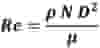
For an agitated tank, the Reynolds number formula is:

where:

  • ρ = Fluid density (volumetric mass density) in kg·m⁻³
  • N = Impeller rotation speed in rev·s⁻¹ (rpm/60)
  • D = Impeller diameter in m
  • μ = Fluid dynamic viscosity in Pa·s (1 Pa.s = 1 P = 1000 cP)
equation-re-mr-mixing

Because the Reynolds number is dimensionless, it is independent of the unit system or the relative size of the system. The only requirement is to keep units consistent, such as using SI units as in our example.

Understanding Flow Regimes in Tank Mixing: Laminar vs. Turbulent

When mixing in a tank, the Reynolds number (Re) tells us how the fluid will flow. The appearance of turbulent motion corresponds to a Reynolds number of about 3,000.

As this number rises, turbulence increases, leading to noticeable changes in the mixing operation appearance. This becomes completely turbulent for a Reynolds number above 6,000.

  • Re < 3,000: the flow is laminar.

The flow is slow and smooth and layered, meaning that two separate flows move in the same direction in parallel layers, involving a slow mixing.

This occurs with high viscous fluids like adhesives, polymers, wastewater sludge or creams. Low-shear impellers are used to avoid damaging the product. 

  • 3,000 < Re < 6,000: the flow is transitional, unstable, in between the two states.

This occurs with fluids having medium‑viscosity such as syrups and slurries.

  • Re > 6,000 the flow is turbulent. In industrial mixing, turbulent flow is generally the ideal condition to achieve.

In turbulent regime, the fluid doesn’t flow in layers. The flow is chaotic, energetic, involving an energic mixing, much faster to allow good dispersion and maintain in suspension.

This is the most common flow regime in the industry where industrial mixers are used. Water and solvents for instance, both are low viscous products that can be easily mixed.


Calculation example with water:

Water at 20 °C (68 °F): ρ ≈ 1000 kg·m⁻³, μ ≈ 0.001 Pa·s

  • Impeller diameter: D = 2 m
  • Mixer Rotation Speed: 180 rpm. Then N = 180/60 = 3 s⁻¹

With Re = 12,000,000: the flow is turbulent. Expect strong blending, good suspension (with proper off‑bottom clearance and baffles).

water-example-reynold-number-calculation-milton-roy

Impact of Reynolds Number on Mixer Selection

The Reynolds number directly influences several parameters when selecting and designing a mixer:


Impeller type


Impeller diameter (D)

A larger impeller increases the Reynolds number (as D²), leading to more effective mixing.

  • Larger impeller diameter boosts Re strongly.
  • Anchors with typically D/T ratio ranging from 0.7 to 0.95.
  • Axial‑flow impellers like HXP generally have a D/T ratio ranging from 0.3 to 0.5.

Mixer Rotation Speed (N) and Motor Power

Speeding up the mixer rotational speed (N) increases Reynolds number and push the flow toward turbulence:

  • Increase N to push into turbulence when feasible.
  • Low Re favors high torque and low speed, involving increasing the motor power. Adjust based on power and torque limits.

Fluid viscosity (μ)

High viscous fluids, meaning a low Re, are harder to mix, and risk stagnant zones.

Frequently Asked Questions on Reynolds Number

It identifies the flow regime in your tank. That regime controls mixing quality, energy use, impeller choice, and sizing rules. Using Re early avoids costly redesigns and poor results.
