
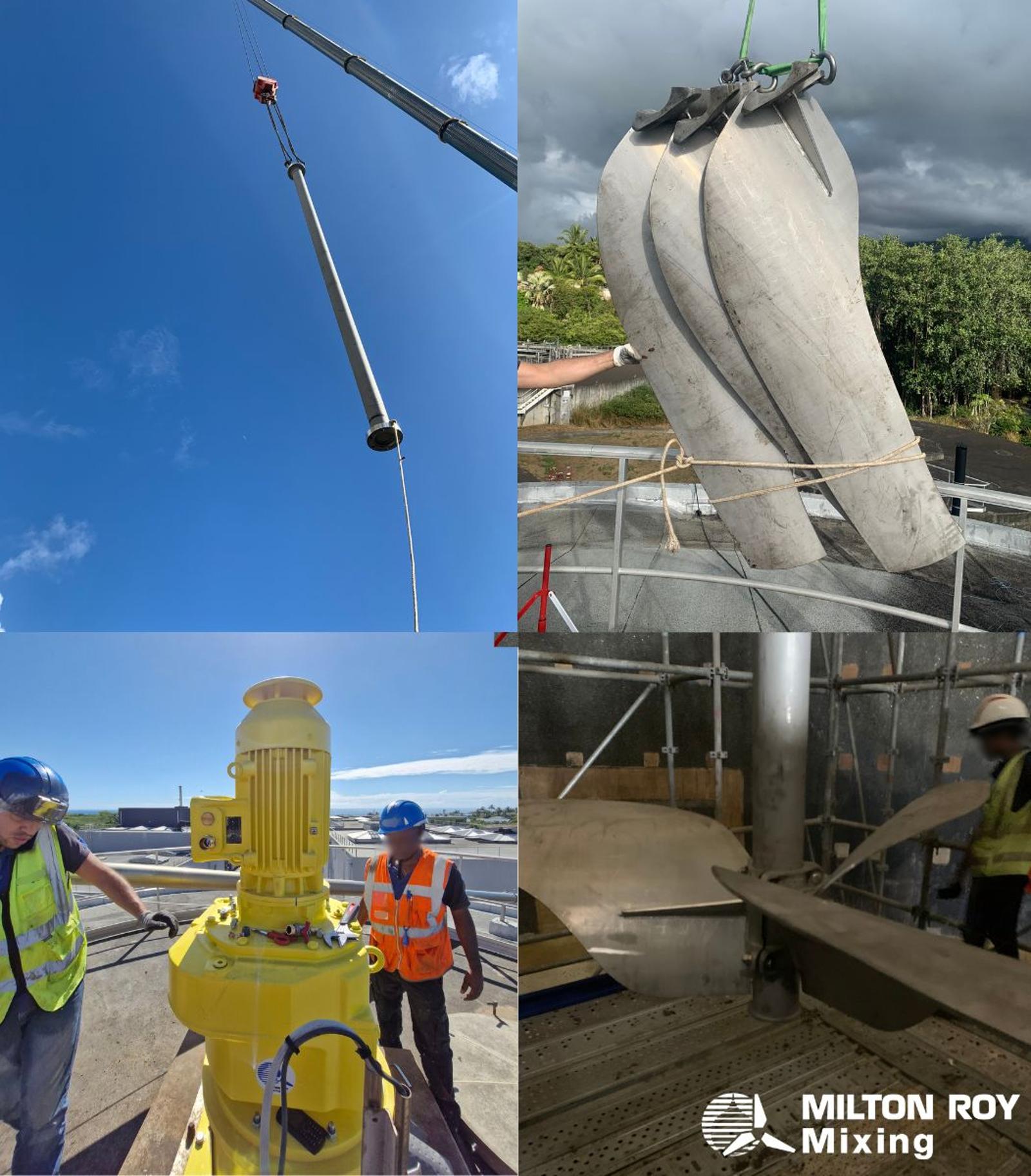
On Réunion Island — a French territory pushing hard toward waste-to-energy and grid autonomy — the Milton Roy Mixing team recently completed the replacement of a top-entry agitator inside a biogas digester. It is a small intervention with an outsized effect, because the mixer sits at the heart of one of the most sensitive biological processes in the renewable-energy chain. Get the agitation right and the digester runs stable and productive; get it wrong and methane yield, temperature control and process reliability all suffer.

In a digester, mixing is not a utility — it is a process variable that decides how much methane the biology actually produces.
Why mixing decides digester performance
Anaerobic digestion is a living process. A microbial community converts organic matter into biogas through a four-step chain, and those microorganisms are highly sensitive to their local conditions — temperature, pH, substrate contact and the build-up of inhibitors. Mixing is what keeps those conditions uniform across the whole tank rather than only near the feed point. Independent studies are unambiguous on the payoff: improving mixing has been shown to raise biogas production by roughly 15–18% and to cut stagnant "dead zones" in the reactor from around 18% of the volume down to ~2%.
A well-specified digester mixer does four things at once:
- Promotes biogas release and biomass–bacteria contact — keeping fresh substrate in constant contact with the microbial population, so conversion is faster and more complete, and gas bubbles are released rather than trapped in the sludge.
- Holds temperature uniform — eliminating hot and cold pockets so methanogens stay in their narrow mesophilic (35–40 °C) or thermophilic (50–57 °C) comfort band, where reaction rate is highest.
- Prevents sedimentation and crust/scum formation — stopping heavy solids from settling and light material from forming a surface crust, both of which shrink the active reactor volume and physically block biogas from rising.
- Buffers the biology against upsets — distributing incoming feed and alkalinity so local pH drops and inhibitor concentrations (such as ammonia) are diluted below the level that would stall methanogenesis.
Case Study - The mixer installed on Réunion Island
The unit installed is a top-entry digester mixer built around Milton Roy's high-efficiency SABRE axial-flow propeller.
Top-entry agitation suits enclosed digester tanks where a strong, vertical, whole-tank flow pattern is needed to keep solids in suspension and the surface free of crust.
The design is engineered specifically for the harsh, abrasive, rag-laden reality of a working digester:
Design feature | What it delivers on site |
Hydraulic seal system | No wear parts on the seal, and maintenance-free sealing — critical for a tank you do not want to open |
High-efficiency SABRE axial-flow propeller | Strong axial flow that minimizes rag accumulation and improves overall mixer reliability |
Energy-efficient hydraulic design | High displaced volume per kW — lower operating cost and a smaller carbon footprint |
Heavy-duty construction | Built for continuous duty in a corrosive, solids-laden environment and long service life |
Optimized CAPEX + OPEX | A total-cost approach that keeps the digester profitable over its whole life, not just at purchase |
Because no two digesters are identical, Milton Roy Mixing offers the agitation format to match the tank, not the other way around: top-entry mixers for enclosed digester tanks, side-entry mixers where roof access is limited or tank geometry demands it, and compact mixers for reception and mixing pits upstream of the digester.
One integrated solution across the biogas process
Mixing is one stage of a connected process — and as an Ingersoll Rand business, Milton Roy can support the whole of it. Each brand stays in its lane, which is exactly what keeps a biogas plant reliable end-to-end:
Process need | IR / Milton Roy solution | Role |
Digester agitation & homogenization | Milton Roy Mixing — top-entry, side-entry, pit mixers (SABRE propeller) | Stabilizes digestion, maximizes methane yield |
Feedstock supply & digestate transfer | Albin Pump — peristaltic hose pumps | Handles viscous, abrasive, solids-laden media with ease |
Process chemistry & additive injection | Milton Roy dosing pumps | Accurate, reliable dosing of any process chemical |
Biogas odorization (final stage) | YZ Systems | Safe, accurate odorization before use or injection |
Where the mixer fits the wider RNG chain?
Talk to our biogas team
Whether you are specifying a new digester, replacing an ageing agitator, or troubleshooting poor methane yield, Milton Roy's mixing and dosing specialists can match the right solution to your tank and your process.