After effluent chlorination disinfects treated wastewater, residual chlorine must be neutralized before discharge to receiving waters. Even low concentrations of free or combined chlorine are toxic to fish, invertebrates, and aquatic ecosystems, and can form harmful organochlorine byproducts. Most discharge permits — including U.S. NPDES permits and EU IED authorizations — mandate non-detect or very low chlorine residuals (typically < 0.1 mg/L) in final effluent.

Dechlorination removes residual chlorine from a water stream that has already been disinfected. It is one of the most precision-critical dosing applications in water treatment: the reaction is rapid (15–30 seconds), the target residual is often near the detection limit, and the consequence of underdosing or overdosing affects both regulatory compliance and downstream process integrity.
While dechlorination is best known as the final step before wastewater discharge, it is equally critical in three other applications: protecting reverse osmosis membranes from oxidative damage, conditioning water for sensitive aquatic processes, and supporting carrier-water systems where residual chlorine would interfere with downstream chemistry. Milton Roy provides the metering pumps and engineered systems that deliver dechlorination accuracy at every scale and application.
Applications of Dechlorination

How Dechlorination Works
Dechlorination is accomplished by adding a reducing agent that reacts with and neutralizes residual chlorine. The reaction is rapid — typically complete within 15 to 30 seconds — but requires accurate, continuous chemical dosing that matches the actual chlorine residual in the flow. Underdosing leaves toxic chlorine in the discharge. Overdosing wastes chemical, depresses dissolved oxygen in receiving waters, and can drive pH excursions.

The 4 Dechlorination Agents
Reducing agent | Form | Typical dose ratio | Best use |
Sulfur dioxide (SO₂) | Compressed gas | ≈ 0.9 mg SO₂ per mg Cl₂ | Large municipal plants with gas-feed infrastructure |
Sodium bisulfite (NaHSO₃) | 38–40 % liquid solution | ≈ 1.5–3.0 mg per mg Cl₂ | Most municipal plants, all RO pretreatment |
Sodium metabisulfite (Na₂S₂O₅) | Powder dissolved in solution | ≈ 1.4 mg per mg Cl₂ | Industrial / RO with on-site solution prep |
Ascorbic acid (vitamin C) | Liquid solution | ≈ 2.5 mg per mg Cl₂ | Sensitive aquatic discharges, release events |
Why Dosing Accuracy Determines Outcomes
- Underdosing
Toxic chlorine residual remains; NPDES violation; aquatic toxicity; RO membrane oxidation. - Overdosing
Wasted chemical; dissolved-oxygen depletion in receiving waters; pH depression; in RO systems, microbial regrowth on excess sulfite. - Variable dosing
Inability to demonstrate compliance with continuous-monitoring requirements; failed permit reporting. - Closed-loop ORP control
The gold standard. ORP sensors measure the redox state in real time; metering pumps adjust dose proportionally.
Milton Roy pumps integrate natively with ORP, conductivity, and chlorine-residual analyzers via 4–20 mA and pulse inputs.
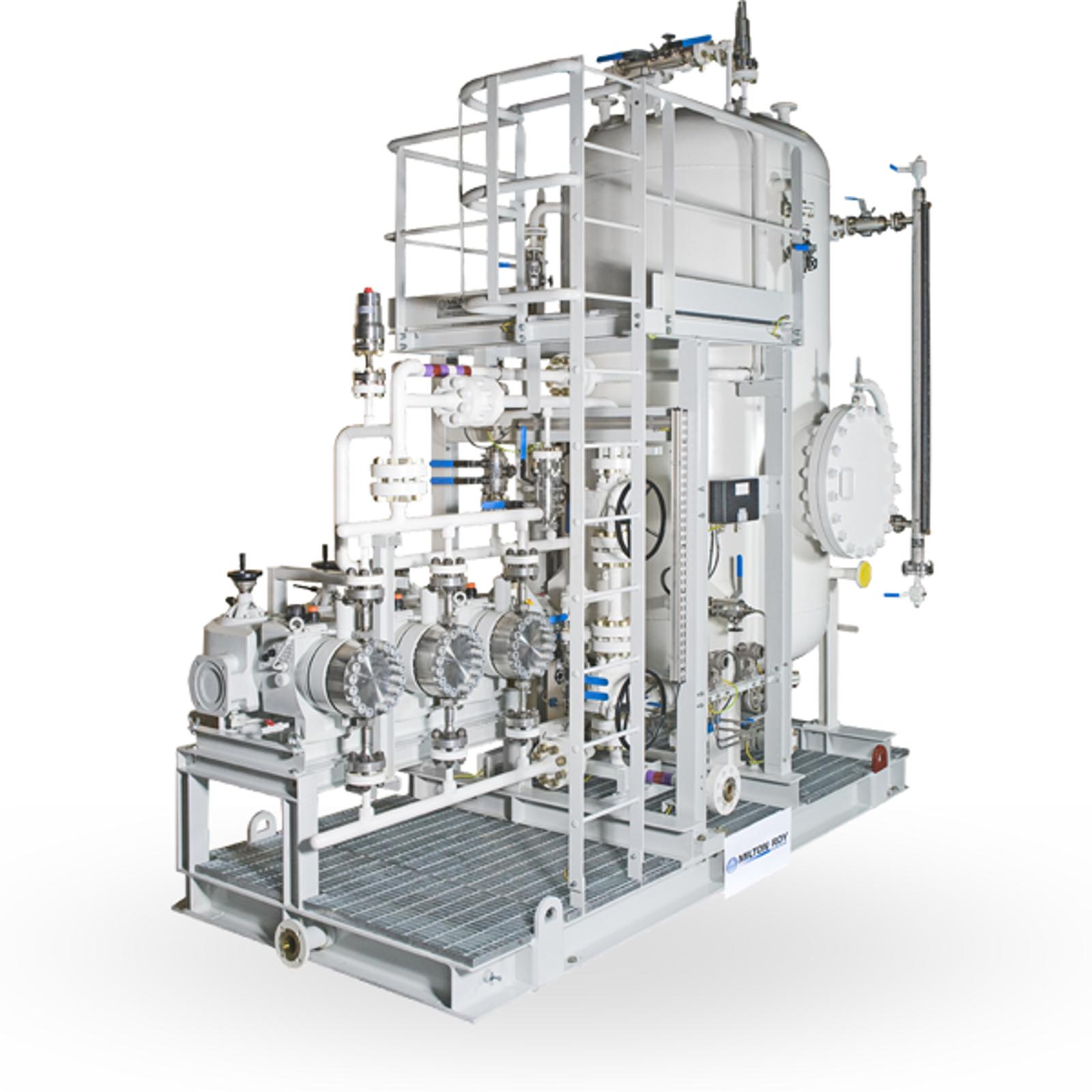
Protect Aquatic Life. Meet Your Permit. Control Your Costs.
Dechlorination is a non-negotiable regulatory requirement for facilities that use chlorine-based disinfection.
Milton Roy's precision dosing systems ensure that your facility consistently meets permit limits for residual chlorine — protecting receiving water ecosystems, avoiding permit violations, and optimizing chemical consumption to control operating costs.