Before any inhibitor is dosed, the underlying water chemistry must be stabilized. Aggressive, low-alkalinity, or low-pH water dissolves pipe materials directly. Over-saturated water scales pipes and damages downstream equipment. Stable water chemistry — defined by the Langelier Saturation Index (LSI), Ryznar Stability Index (RSI), and Calcium Carbonate Precipitation Potential (CCPP) — is the precondition for every inhibitor program to work.

Corrosion in a drinking water distribution network is not a single problem — it is a slow, compound risk that simultaneously threatens public health, infrastructure value, water quality, and regulatory compliance. Lead leaches from service lines. Iron releases generate red water and customer complaints. Copper pinholes cause failures in premise plumbing. Cement linings deteriorate. And every kilometer of pipe ages faster than it should.
Effective corrosion control is therefore never a single chemical injection. It is an engineered, multi-chemical program — built around water chemistry, pipe materials, distribution system age, and regulatory targets — and delivered through precision dosing systems that maintain stability over decades.
Milton Roy provides the engineered systems, process expertise, and regulatory guidance that utilities need to design, commission, and sustain corrosion control programs that work — and that pass every audit.
The 3 Pillars of a Modern Corrosion Control Program
The Engineered Multi-Chemical Approach
A best-in-class corrosion control program combines three to four chemical injection points working in concert:
Function | Chemical(s) | Target |
pH stabilization | Caustic, soda ash, lime | Distribution pH 7.5–9.0 |
Alkalinity / hardness adjustment | Soda ash, lime, CaCO₃ contactors | Alkalinity ≥ 30 mg/L; CCPP near zero |
Inhibitor dosing | Orthophosphate or zinc orthophosphate (ZOP) | Distribution OP residual 0.5–3.0 mg/L |
Stabilization monitoring | LSI / RSI / CCPP + lead-tap monitoring | Stable film, no excursions |
Why Each Pillar Needs Engineered Dosing
- Stability over decades
Corrosion-control films take months to form and years to mature. Variable dosing destabilizes the film and releases accumulated lead. Milton Roy ±1 % steady-state accuracy maintains the chemistry that maintains the film. - Multi-chemical coordination
Inhibitor effectiveness depends on pH and alkalinity. A weakness in any one stream undermines the whole program.
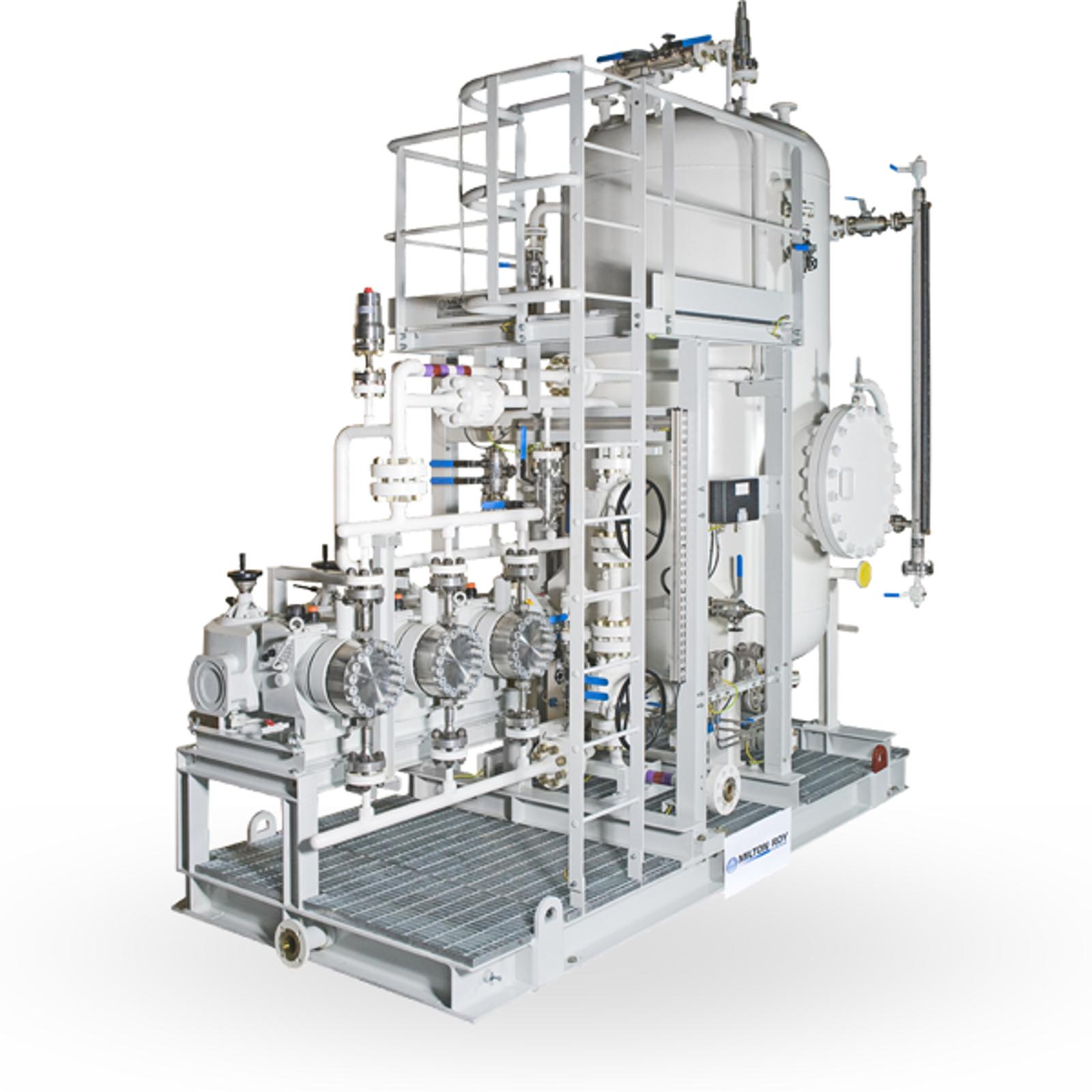
Milton Roy engineered packages coordinate all injection points under a single control logic. - Slurry + acid + caustic + phosphate
Each requires its own materials, valves, sensors, and operating logic. Pre-engineered DOSASKID system delivers this complexity as a single tested package. - Regulatory documentation
LCRI requires continuous demonstration of corrosion control treatment. Pumps with alarms and SCADA outputs make the audit trail automatic.
The Regulatory Landscape. Why Corrosion Control Is Non-Negotiable
- U.S. Lead and Copper Rule Improvements (LCRI)
Enforces lead service line replacement plus mandatory corrosion control treatment for systems with action-level exceedances. Effective 2027. - EU Drinking Water Directive (revised 2020)
Lowers the lead action level to 5 µg/L (from 10 µg/L) by 2036 and explicitly references corrosion control. - Health Canada Guideline for Lead
5 µg/L MAC, with corrosion control treatment as the recommended risk-management measure. - Asia-Pacific & Middle East
Increasingly aligned with WHO drinking water guidelines (10 µg/L lead) and adopting corrosion control programs as new networks are built.