Products
Metering Pumps
Process Pumps
Mixers
Systems & Skids
Electronics and Metering
Valves and Accessories
Industries & Applications
Water Treatment
Energy
Mining & Mineral Processing
Chemical Industry
General industry
Technology
Metering Pump Technology
Metering Pump Principles
Petrochemical Industry
About Us & Aftermarket
News
Careers
CARE Maintenance Plans
Spare Parts Inventory
Resources
Document Library
White Paper
Case Studies
Webinars on Demand
Digital Support Files
Certifications
Milton Roy YouTube Channel
Sales Terms & Conditions

pH and alkalinity are not just two parameters on a lab report — they are the master variables that govern every other chemistry decision in a water treatment plant. Coagulation efficiency, disinfection effectiveness, corrosion behavior, lead leaching, scale formation, and biological-treatment performance all depend on holding pH and alkalinity within tight, application-specific windows. Get them right, and downstream chemistry costs less, performs better, and protects infrastructure for decades. Get them wrong, and every other process step pays a penalty.

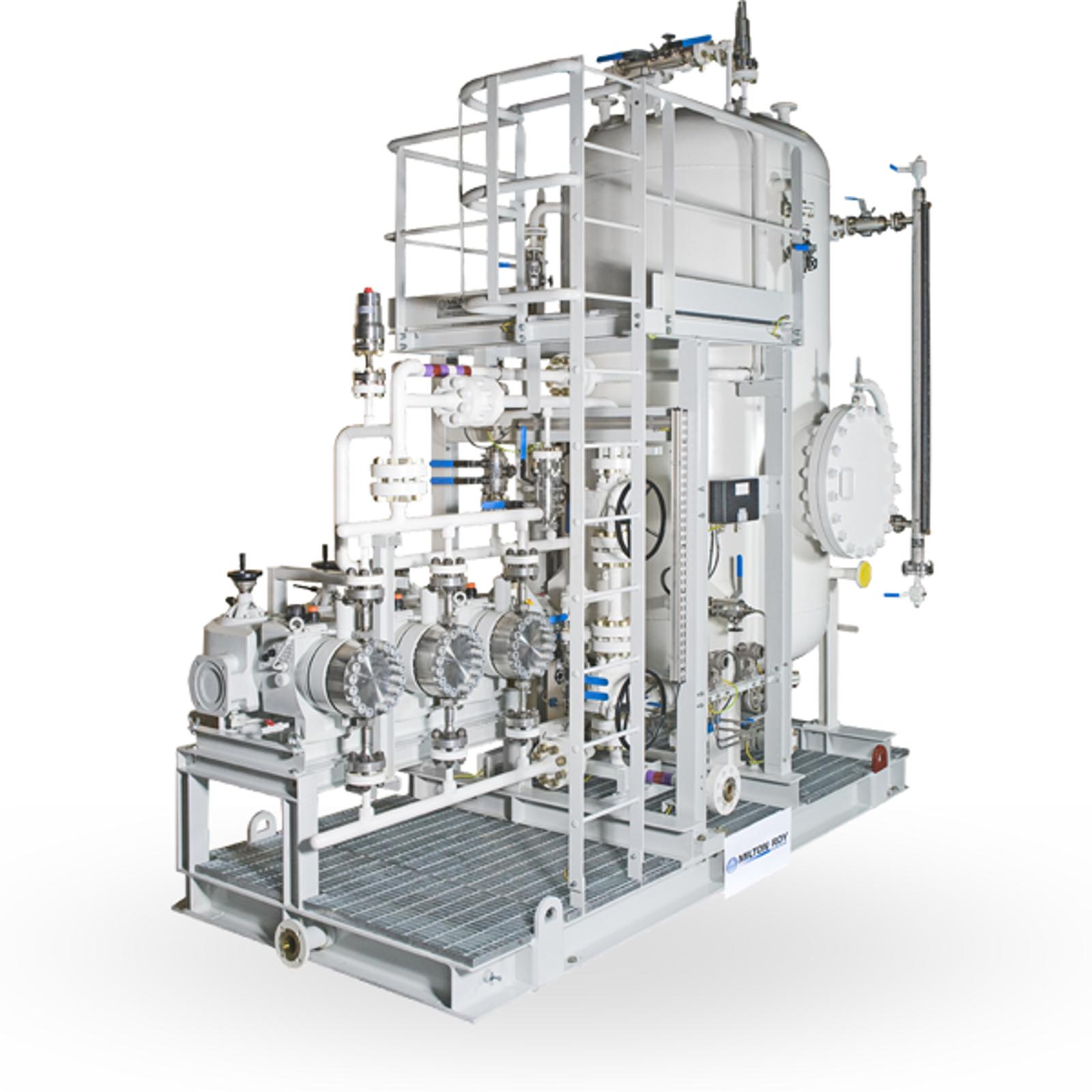
Milton Roy designs and supplies the engineered dosing skids, precision metering pumps, and mixing systems that make pH and alkalinity correction repeatable at municipal scale — with the flow rates, pressures, and chemical compatibility required for caustic, lime slurry, sulfuric acid, soda ash, and dissolved CO₂.


Why pH and Alkalinity Are the Master Variables

  • Coagulation pH window
    Alum performs optimally at pH 5.5–7.5; ferric chloride at pH 4.5–6.5. Out-of-window pH triples coagulant dose and sludge production.
  • Disinfection efficiency
    Free chlorine speciation shifts from HOCl (effective) toward OCl⁻ (less effective) as pH rises. Disinfection CT requirements depend directly on pH.
  • Corrosion behavior
    The Langelier Saturation Index (LSI), Ryznar Stability Index (RSI), and Calcium Carbonate Precipitation Potential (CCPP) all depend on pH and alkalinity. Water that is undersaturated (LSI < 0) attacks pipes; oversaturated water (LSI > 0) scales them.
  • Lead and copper leaching
    Distribution-system pH targets (typically 7.5–9.0) and alkalinity targets (≥ 30 mg/L as CaCO₃) are mandated by the U.S. Lead and Copper Rule Improvements (LCRI) and the EU Drinking Water Directive.
  • Biological treatment
    Nitrification consumes alkalinity (≈ 7.1 mg CaCO₃ per mg NH₄-N oxidized). Without alkalinity make-up, pH crashes, and nitrification stalls.

Where pH & Alkalinity Are Adjusted in a Drinking Water Plant

A typical drinking water plant adjusts pH and alkalinity at three or four distinct injection points — each with its own chemistry, dose range, and control strategy.

Injection point

Purpose

Typical chemical

Control strategy

Pre-coagulation

Move into the optimal coagulation window

Sulfuric acid or caustic soda

Inline pH probe + flow-paced feedback

Pre-disinfection

Shift Cl₂ speciation toward HOCl for higher CT efficiency

Sulfuric acid

pH controller + flow pacing

Post-treatment / pre-distribution

Stabilize LSI / RSI for corrosion control

Lime slurry, caustic, or soda ash

LSI-based or distribution pH target

Post-desalination remineralization

Restore alkalinity and hardness for distribution stability

Lime + CO₂, or calcite contactors + caustic

Integrated LSI + hardness control

The Chemicals Milton Roy Doses

Chemical

Function

Form & dosing challenge

Sulfuric acid (H₂SO₄)

pH reduction

Concentrated 93–98 % liquid; corrosive; heat of dilution

Hydrochloric acid (HCl)

pH reduction

Off-gassing; aggressive to most metals

Sodium hydroxide (caustic, NaOH)

pH increase, alkalinity boost

Crystallizes below 13 °C in 50 % form; requires heat tracing

Lime (Ca(OH)₂) slurry

pH increase + calcium hardness addition

Slurry: settles, abrades, scales

Soda ash (Na₂CO₃)

Alkalinity boost without hardness

Dissolves on-site; requires solution prep

Dissolved CO₂

pH reduction without sulfate

Gas dissolution requires diffusers


The Engineered-Systems Difference

pH and alkalinity correction is rarely a simple pump-and-tank installation. Lime slurry requires continuous recirculation and abrasion-resistant components. Concentrated sulfuric acid generates heat on dilution and requires safety-rated materials. Caustic solidifies in cold weather. CO₂ requires gas-phase delivery and dissolution control. 

Milton Roy engineered DOSASKID systems address each of these challenges in pre-assembled, factory-tested units — dramatically reducing engineering, commissioning, and risk for the utility or EPC contractor.

Why Milton Roy for pH & Alkalinity Correction

  • Multi-chemical authority
    Engineered systems for acids, caustics, lime slurry, soda ash, and CO₂.
  • Slurry expertise
    MAD pumps and industrial mixers designed for abrasive, scale-forming lime and ferric slurries.
  • High-pressure capability
    HAD hydraulically actuated diaphragm pumps for inline acid injection.
  • Index-based control
    Engineering support for LSI, RSI, and CCPP target setting and process integration.
  • Regulatory alignment
    Direct support for LCRI, EU DWD revision, and emerging international standards.
  • Engineered packages
    DOSASKID and custom skids deliver fully assembled, ready-to-commission systems.

For smaller installations, distribution-system booster stations, and OEM water-treatment skids, Ingersoll Rand sister brand LMI provides compact, NSF 61–certified chemical metering pumps engineered for acid, caustic, and soda-ash dosing — the perfect complement to Milton Roy's engineered municipal systems.