

Products
Metering Pumps
Process Pumps
Mixers
Systems & Skids
Electronics and Metering
Valves and Accessories
Industries & Applications
Water Treatment
Energy
Pyrolysis Plastics Recycling
Lithium Mining
Essential Pil Extraction
Palm Oil Production
Technology
Water Treatment
Energy
General Industry
Metering Pump Technology
Metering Pump Principles
Petrochemical Industry
Aftermarket & Support
CARE Maintenance Plans
Spare Parts Inventory
Resources
White Paper
Case Studies
Webinars on Demand
Digital Support Files
Certifications
Milton Roy YouTube Channel
Sales Terms & Conditions
About Us
News
Knowledge Hub
Careers
Sign Up for Newsletter

Water is an indispensable resource — and yet over 40% of the global population faces challenges accessing potable water. Although two-thirds of the Earth's surface is covered with water, only 2.5% is freshwater and just 0.3% is fit for human consumption. The remaining 96% sits in oceans and seas, unusable without desalination.

That reality is driving massive investment. The global desalination market was valued at USD 10.65 billion in 2025 and is projected to reach USD 26.49 billion by 2034, growing at a CAGR of 10.66%. Reverse osmosis now accounts for over 65% of all new desalination capacity worldwide — and every RO train depends on precise, stage-by-stage chemical injection to produce safe, stable water.

But the desalination core process — reverse osmosis membrane technology — does not, on its own, provide safe drinking water or guarantee an efficient plant. It is the chemical dosing at every stage — from intake chlorination to post-treatment remineralization — that determines plant lifetime, minimizes chemical cleaning and membrane replacement, and directly impacts overall performance.

The Five Stages of Desalination, and Why Chemical Dosing Matters at Every One

A desalination plant is not a single process. It is a treatment chain built across five distinct stages, each with its own chemical dosing requirements:

  1. Intake: Getting water from its source to the processing facility. Chemical dosing begins here with disinfection to control biological growth before the water even enters the plant.
  2. Pretreatment: Removing suspended solids, organic matter, and colloidal particles to prepare the water for membrane processing. This stage is determining for plant lifetime and is the single most important factor in minimizing chemical cleaning frequency and membrane replacement costs.
  3. Desalination (RO): Removing dissolved solids — primarily salts and inorganic matter — through reverse osmosis membranes. Anti-scalant and dechlorination dosing protect the membranes during this critical separation step.
  4. Post-treatment: Adding chemicals to desalinated water to prevent corrosion of downstream infrastructure, adjust mineral content, and ensure the water meets drinking or process water specifications.
  5. Concentrate management and freshwater storage: Handling and disposing or reusing the brine waste from the desalination process and storing freshwater before distribution.

The majority of technological advancements have occurred at Stage 3 but scaling and fouling remain among the main causes of RO plant failure — problems that originate in Stages 1 and 2 when chemical dosing is inconsistent or improperly controlled.
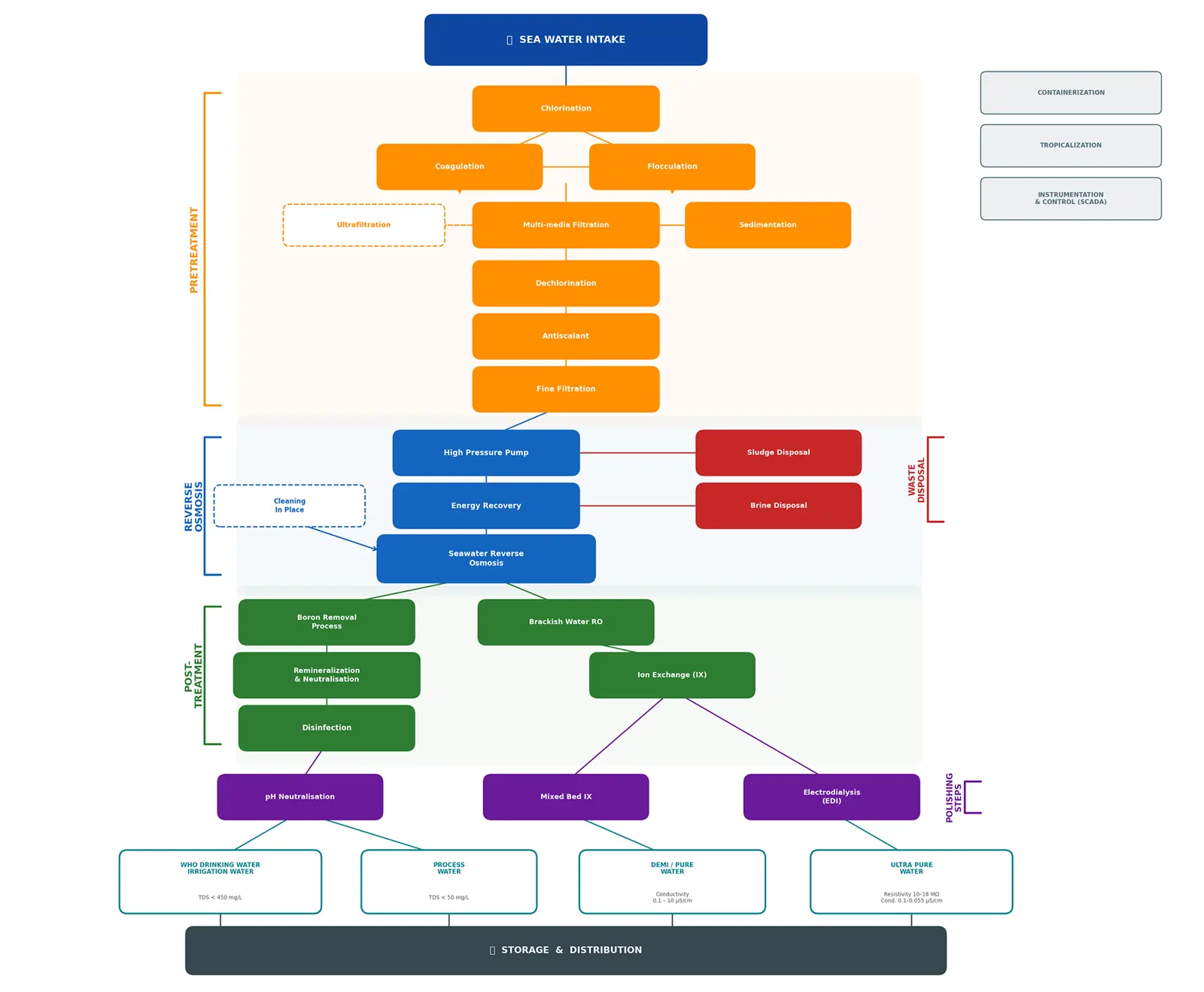
Chemical Dosing in SWRO - The Complete Injection Map

An SWRO plant requires dosing of many chemicals across the treatment train.
The type and quantity of chemicals depend on the specific seawater chemistry, but the following injection points are typical for most RO desalination facilities:

desalination process diagram

At the intake, sodium hypochlorite (NaOCl) is dosed for two distinct functions: continuous seawater chlorination to suppress marine biological growth, and intermittent shock dosing to prevent bacteria from adapting to a constant chlorine concentration.
This dual-mode dosing strategy requires metering equipment that can switch between steady-state feed and high-rate pulse injection without compromising accuracy in either mode.

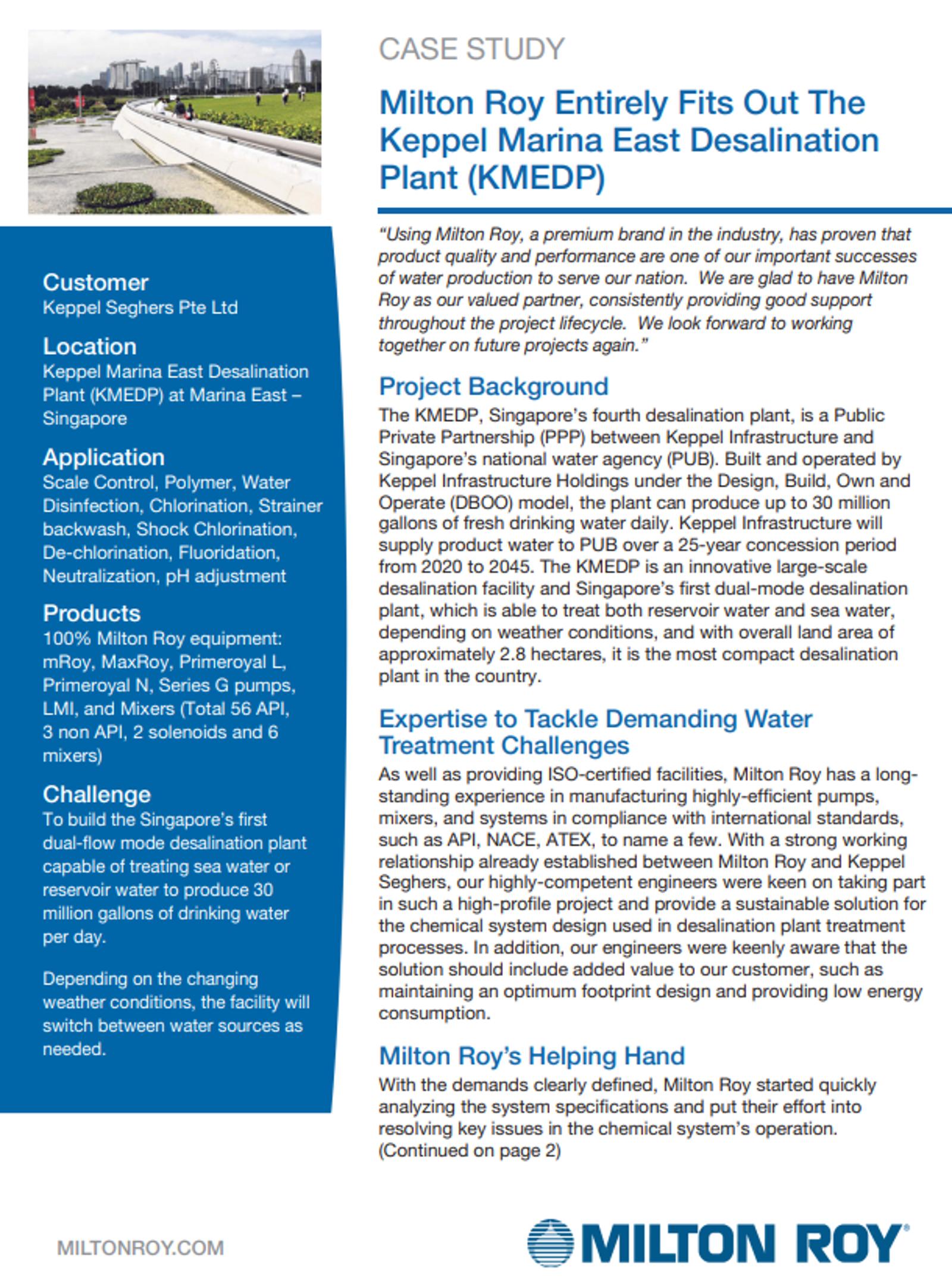
100% Milton Roy — Inside Singapore's First Dual-Mode Desalination Plant

When Keppel Infrastructure set out to build the world's first dual-mode desalination plant — capable of switching between seawater and reservoir water to produce 30 million gallons of drinking water per day — they needed a chemical dosing partner that could cover every stage of the treatment chain. 

Milton Roy delivered the entire chemical injection system: 56 API metering pumps, 6 industrial mixers, and complete dosing solutions for chlorination, dechlorination, scale control, fluoridation, pH adjustment, and neutralization. 

No second supplier. No compromise. Read how Milton Roy fully equipped the Keppel Marina East Desalination Plant in Singapore, from intake to distribution.

Keppel desalination case study image