Products
Metering Pumps
Process Pumps
Mixers
Systems & Skids
Electronics and Metering
Valves and Accessories
Industries & Applications
Water Treatment
Energy
Pyrolysis Plastics Recycling
Lithium Mining
Essential Pil Extraction
Palm Oil Production
Technology
Metering Pump Technology
Metering Pump Principles
Petrochemical Industry
Aftermarket & Support
CARE Maintenance Plans
Spare Parts Inventory
Resources
White Paper
Case Studies
Webinars on Demand
Digital Support Files
Certifications
Milton Roy YouTube Channel
Sales Terms & Conditions
About Us
News
Knowledge Hub
Careers
Sign Up for Newsletter

pH and alkalinity are not just two parameters on a lab report — they are the master variables that govern every other chemistry decision in a water treatment plant. Coagulation efficiency, disinfection effectiveness, corrosion behavior, lead leaching, scale formation, and biological-treatment performance all depend on holding pH and alkalinity within tight, application-specific windows. Get them right, and downstream chemistry costs less, performs better, and protects infrastructure for decades. Get them wrong, and every other process step pays a penalty.

Milton Roy designs and supplies the engineered dosing skids, precision metering pumps, and mixing systems that make pH and alkalinity correction repeatable at municipal scale — with the flow rates, pressures, and chemical compatibility required for caustic, lime slurry, sulfuric acid, soda ash, and dissolved CO₂.


Why pH and Alkalinity Are the Master Variables

  • Coagulation pH window
    Alum performs optimally at pH 5.5–7.5; ferric chloride at pH 4.5–6.5. Out-of-window pH triples coagulant dose and sludge production.
  • Disinfection efficiency
    Free chlorine speciation shifts from HOCl (effective) toward OCl⁻ (less effective) as pH rises. Disinfection CT requirements depend directly on pH.
  • Corrosion behavior
    The Langelier Saturation Index (LSI), Ryznar Stability Index (RSI), and Calcium Carbonate Precipitation Potential (CCPP) all depend on pH and alkalinity. Water that is undersaturated (LSI < 0) attacks pipes; oversaturated water (LSI > 0) scales them.
  • Lead and copper leaching
    Distribution-system pH targets (typically 7.5–9.0) and alkalinity targets (≥ 30 mg/L as CaCO₃) are mandated by the U.S. Lead and Copper Rule Improvements (LCRI) and the EU Drinking Water Directive.
  • Biological treatment
    Nitrification consumes alkalinity (≈ 7.1 mg CaCO₃ per mg NH₄-N oxidized). Without alkalinity make-up, pH crashes, and nitrification stalls.

Where pH & Alkalinity Are Adjusted in a Drinking Water Plant

A typical drinking water plant adjusts pH and alkalinity at three or four distinct injection points — each with its own chemistry, dose range, and control strategy.

Injection point

Purpose

Typical chemical

Control strategy

Pre-coagulation

Move into the optimal coagulation window

Sulfuric acid or caustic soda

Inline pH probe + flow-paced feedback

Pre-disinfection

Shift Cl₂ speciation toward HOCl for higher CT efficiency

Sulfuric acid

pH controller + flow pacing

Post-treatment / pre-distribution

Stabilize LSI / RSI for corrosion control

Lime slurry, caustic, or soda ash

LSI-based or distribution pH target

Post-desalination remineralization

Restore alkalinity and hardness for distribution stability

Lime + CO₂, or calcite contactors + caustic

Integrated LSI + hardness control

Contact us to discuss your project

Milton Roy's application specialists match the right pump technology, materials of construction, and system configuration to your specific chemical and application requirements.

The Chemicals Milton Roy Doses

Chemical

Function

Form & dosing challenge

Sulfuric acid (H₂SO₄)

pH reduction

Concentrated 93–98 % liquid; corrosive; heat of dilution

Hydrochloric acid (HCl)

pH reduction

Off-gassing; aggressive to most metals

Sodium hydroxide (caustic, NaOH)

pH increase, alkalinity boost

Crystallizes below 13 °C in 50 % form; requires heat tracing

Lime (Ca(OH)₂) slurry

pH increase + calcium hardness addition

Slurry: settles, abrades, scales

Soda ash (Na₂CO₃)

Alkalinity boost without hardness

Dissolves on-site; requires solution prep

Dissolved CO₂

pH reduction without sulfate

Gas dissolution requires diffusers


The Engineered-Systems Difference

pH and alkalinity correction is rarely a simple pump-and-tank installation. Lime slurry requires continuous recirculation and abrasion-resistant components. Concentrated sulfuric acid generates heat on dilution and requires safety-rated materials. Caustic solidifies in cold weather. CO₂ requires gas-phase delivery and dissolution control. 

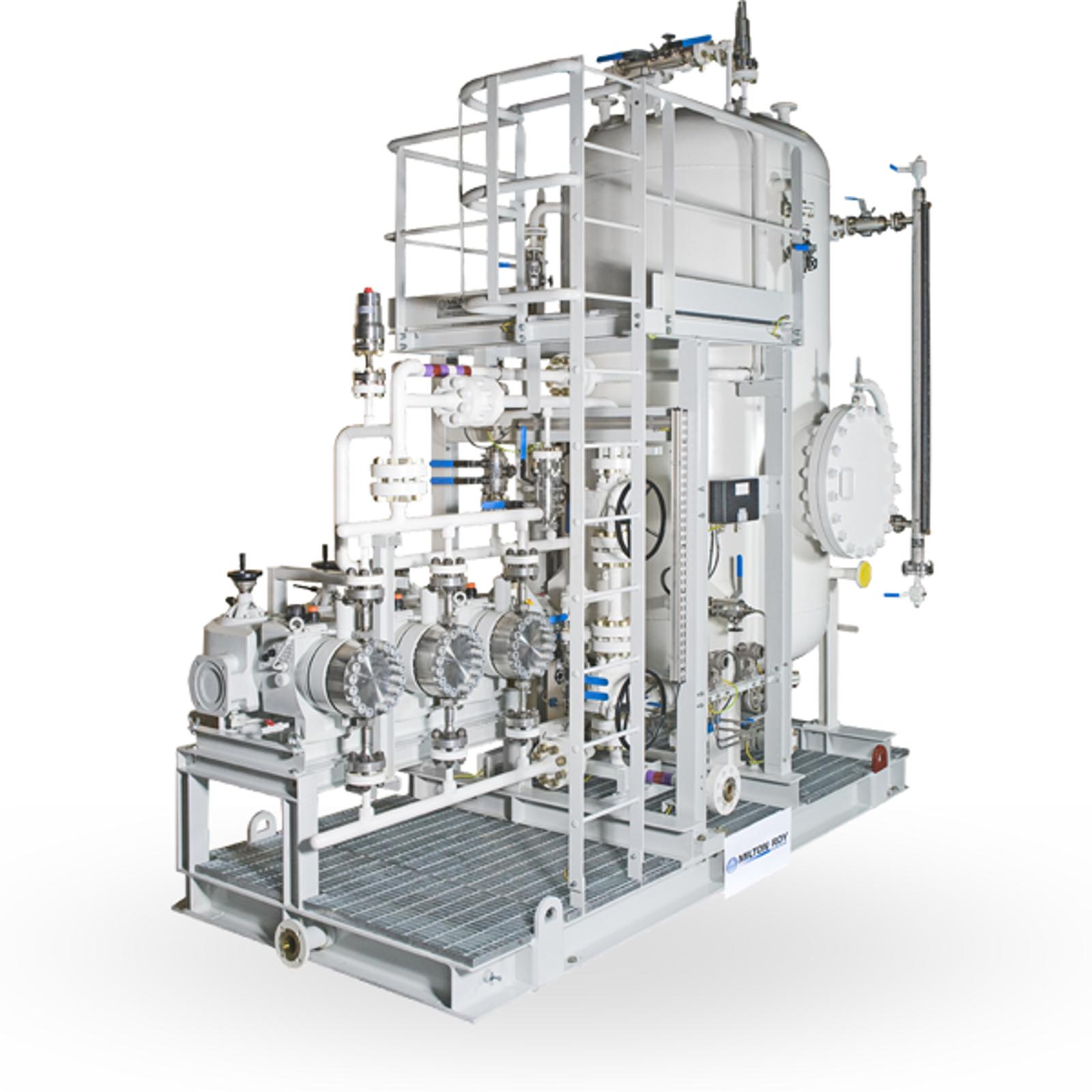
Milton Roy engineered DOSASKID systems address each of these challenges in pre-assembled, factory-tested units — dramatically reducing engineering, commissioning, and risk for the utility or EPC contractor.

Why Milton Roy for pH & Alkalinity Correction

  • Multi-chemical authority
    Engineered systems for acids, caustics, lime slurry, soda ash, and CO₂.
  • Slurry expertise
    MAD pumps and industrial mixers designed for abrasive, scale-forming lime and ferric slurries.
  • High-pressure capability
    HAD hydraulically actuated diaphragm pumps for inline acid injection.
  • Index-based control
    Engineering support for LSI, RSI, and CCPP target setting and process integration.
  • Regulatory alignment
    Direct support for LCRI, EU DWD revision, and emerging international standards.
  • Engineered packages
    DOSASKID and custom skids deliver fully assembled, ready-to-commission systems.

For smaller installations, distribution-system booster stations, and OEM water-treatment skids, Ingersoll Rand sister brand LMI provides compact, NSF 61–certified chemical metering pumps engineered for acid, caustic, and soda-ash dosing — the perfect complement to Milton Roy's engineered municipal systems.